
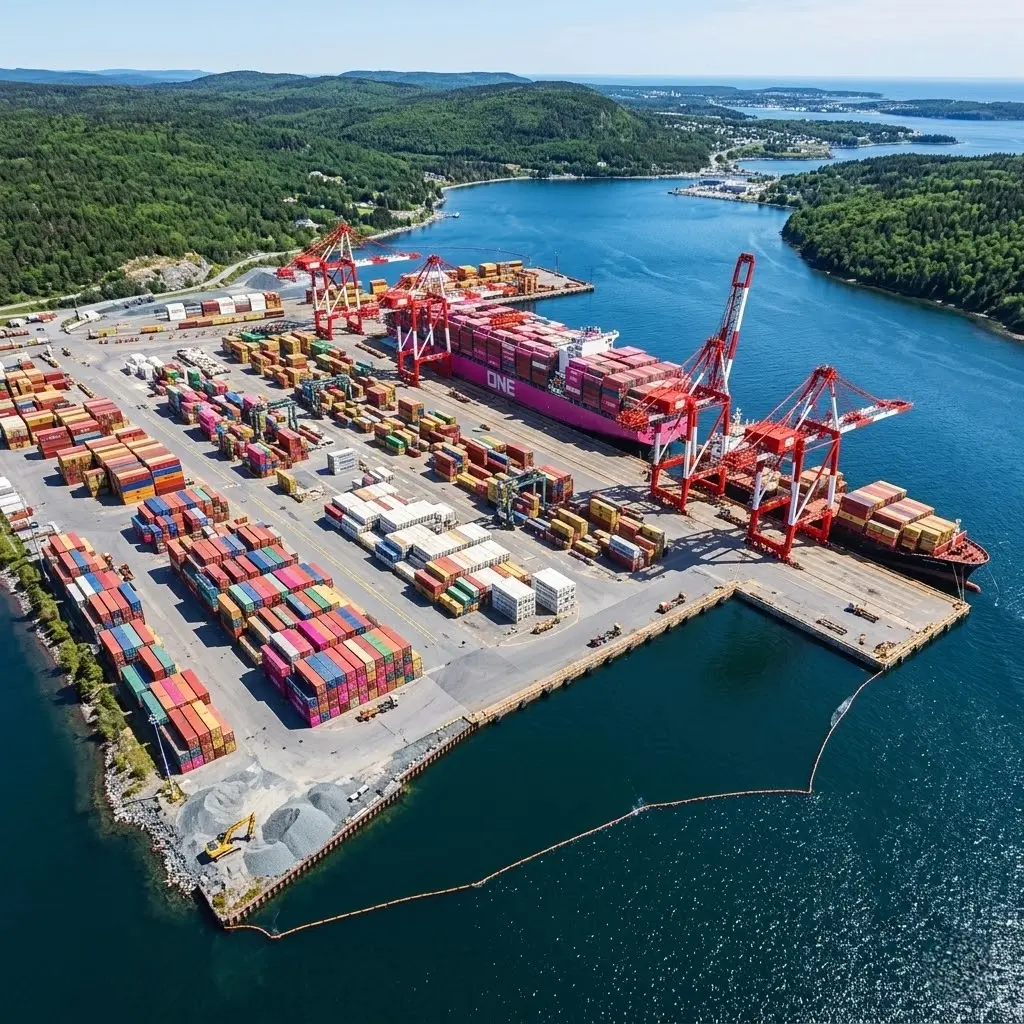
Why African Charcoal Sells Cheap and How to Fix It
African charcoal sells for around US$500 per ton FOB while quality charcoal in Asia moves between US$700 and US$1,200. The gap is grading and packaging, not the raw material.Africa Sells Into a Market That Does Not Grade
African charcoal is not underpaid because it is poor quality. It is underpaid because almost all of it goes to one destination, and that destination does not grade.
The UAE and the wider GCC absorb the bulk of African charcoal exports. It is a large, liquid, fast-paying market — and a market with no established quality standard. Good charcoal and mediocre charcoal clear at close to the same price. When the buyer does not distinguish, the producer has no reason to invest, and the whole origin gets priced as a commodity.
Asia works the other way round. Japanese, Korean and Australian importers specify, test, and reject. That sounds like the harder market. It is precisely why it pays more: where there is a standard, there is a price ladder, and a producer who climbs it gets paid for the climb.
What the Asian Price Ladder Looks Like
Japan is the most demanding and highest-value charcoal import market in the world. Restaurant operators — yakitori and robata in particular — require A1-grade mangrove charcoal with minimal sparking and near-zero smoke. Japanese buyers reject entire containers over variation between bags.
South Korea takes A2 and A3 grade, driven by Korean BBQ restaurant demand. Appearance tolerance is wider than Japan’s, volumes are larger, and the buying cycle is more predictable.
Australia imports mainly B-grade hardwood charcoal for retail and supermarket distribution. More price-sensitive, wider specification tolerance — and the entry point most African producers should look at first.
The ladder matters more than any single rung. In the Gulf there is effectively one price, around US$500 per ton FOB. In Asia the same producer faces a range from US$700 to US$1,200 per ton FOB, and the distance between those two figures is the return on doing the work. Our own published FOB price ranges by grade show where each rung sits.
Three Gaps, and None of Them Are the Charcoal
Packaging. African charcoal ships in unmarked bags. There is no retail packaging, because retail packing requires automation and the automation has not been invested in. This caps the producer at the lowest-margin position in the chain: bulk supplier to someone else’s brand.
This is not a side issue. It is most of the price gap. The Asian range of US$700 to US$1,200 is a packaging range: the same charcoal, unmarked and in bulk, sits at the bottom of it; graded, packed and labelled for retail, it sits at the top. Asian retail and supermarket buyers — Australia especially — buy packed product, and a producer who cannot pack cannot reach them directly at any price.
Credibility. There is a reputational problem in this trade, and legitimate African producers pay for it. Importers have been defrauded often enough that they now treat an unknown African counterparty as a risk until proven otherwise. That is the state of the market a producer has to sell into, and the practical consequence is that the burden of proof sits entirely on the seller — discharged with documents and process, not assurances.
Payment instrument. This is where most deals die, and it is the clearest signal of all. Serious importers pay by Letter of Credit. An LC protects both sides: the buyer’s bank pays only against compliant shipping documents, so the buyer cannot lose the money and the seller cannot lose the cargo. Many African suppliers refuse LC and insist on direct bank transfer.
From the importer’s side that refusal reads as a red flag, because advance transfer is exactly what a fraudulent seller asks for. The real reason is usually capability rather than intent: operating an LC requires a bank that handles documentary credit and the ability to produce document sets that comply exactly. Most producers have never been walked through it.
Accepting LC is the single fastest way an honest African exporter separates itself from the rest. It converts a trust problem into a paperwork problem, and paperwork is teachable.
What Asian Buyers Actually Specify
Fixed carbon (FC) is the primary metric — the percentage of pure carbon remaining after moisture and volatile matter burn off. Higher FC means longer burn, more heat and less ash. Premium Asian grades sit at 75% and above.
Moisture below 5% for premium grades. High moisture makes lighting difficult and cuts effective burn temperature.
Ash below 3% for top grade. Restaurant buyers read ash as a quality signal, not just a cleanup cost.
Spark and smoke. Light a sample on an open grill and watch. Consistent sparking indicates B-grade or below. For Japanese restaurant supply this single behaviour decides acceptance.
Consistency. Variation between bags is read as loss of process control. In a market that grades, inconsistency is worse than a lower grade honestly declared. A fuller breakdown of these metrics is in our charcoal quality guide, and common questions on grades, MOQ and shipping terms are answered in our Q&A.
FSC Is Not the Gate in Asia
Producers who have been selling to Europe often assume certification is the price of entry everywhere. It is not. FSC certification is required in certain European markets. It is not a general requirement for Asian buyers.
What Asian importers test is specification and consistency, shipment after shipment. For a producer who cannot yet carry the cost of certification, Asia is the more accessible market, not the harder one.
Export Legality Is Separate, and Non-Negotiable
Certification is a market preference. Export legality is not, and several African origins cannot ship at all.
Somalia. UN Security Council Resolution 2036 (2012) prohibits the direct or indirect import of Somali charcoal by all member states, whether or not the charcoal originated there. The Security Council reaffirmed the ban in 2025. A single one-off exemption was granted in 2023 for disposal of a specific stockpile.
Nigeria. A Presidential Executive Order prohibiting the export of wood and allied products — charcoal explicitly included — was gazetted on 16 October 2025, revoking all previously issued export licences and permits.
East African Community. The EAC Customs Management Act (2004) lists charcoal as a restricted good and prohibits its export outside the community, covering Kenya, Tanzania, Uganda, Rwanda, Burundi, South Sudan and the DRC. Uganda has separately banned charcoal export since amending its External Trade Act in 1987.
Zambia. No national export ban, but cordwood permits for charcoal production have been suspended in Itezhi-tezhi, Mumbwa and Shibuyunji since April 2024, with stated intent to extend nationwide.
Namibia and South Africa have functioning legal export frameworks, produce from bush encroachment rather than native forest, and have established port and export infrastructure. Documentation requirements by destination are covered in our guide to trade compliance and export documentation, and freight costs in our charcoal shipping cost guide.
A warning that cuts both ways: UN monitors have documented Somali charcoal being relabelled as originating elsewhere and re-exported with falsified certificates of origin. Paper origin is not verification, and an origin that cannot survive scrutiny damages the credibility of every legitimate exporter on the continent.
Working With Matsuri International
Matsuri International Co., Ltd has manufactured and exported charcoal from Thailand since 2003, shipping to more than 30 countries. We know what Asian buyers specify, what they reject and why, because we have been on the supply side of that transaction for over twenty years.
Buyer matching — introducing verified exporters to Asian wholesale importers whose grade requirements match what you actually produce.
Export consultancy — specification, packing, documentation and payment structure, including how to operate a Letter of Credit.
Charcoal is classified as a dangerous good under IMDG, which narrows the list of carriers that will accept it and adds documentation most producers have never had to prepare. Dangerous goods shipments are handled through Mars & Sons (HK) Global, a specialist DG shipping agent.
More market and compliance guides are in our Insights section. Tell us your origin, grade and monthly capacity.
About Matsuri International
Thailand charcoal manufacturer and exporter since 2003. A1–A4 grade mangrove charcoal, BBQ hardwood, briquettes, shisha charcoal, and industrial powder. Export to 30+ countries.